viernes, 27 de enero de 2023

  “Flores Mexicanas: A Lindbergh Love Story” soars beyond the famed aviator’s historic flight and reveals the connection between a poet, a pilot, a president, and a painter that altered the course of aviation history and left a lasting legacy on U.S.–Mexico relations.


ABOUT FLORES MEXICANAS

In 1929 Mexican president Emilio Portes Gil gave the Lindberghs the Martinez masterpiece as a wedding gift. Mexico was significant to the Lindberghs as the place where their love story began. For the Mexican government, the gift was a chance to impress the daughter and son-in-law of the United States’ respected ambassador to Mexico, Dwight Morrow — Anne’s father.

Martinez started working on “Flores Mexicanas” long before anyone had heard of Charles or Anne Lindbergh. He spent about 15 years working on the piece before it was completed and purchased by President Emilio Portes Gil. “Flores Mexicanas” was Martinez’s last work completed in Mexico before he moved to Los Angeles in 1929 and one of his final paintings with strong European influence before he took up the modernist style for which he has become known and loved.

Charles Lindbergh later entrusted “Flores Mexicanas” and many of his other gifts and awards to the care of the Missouri Historical Society. Safely stored at the Missouri Historical Society’s Library and Research Center for decades, many art scholars were unaware of the location of “Flores Mexicanas.”


martes, 20 de diciembre de 2022

 Madonna and Child was painted by one of the most influential artists of the late 13th and early 14th century, Duccio di Buoninsegna. This iconic image of the Madonna and Child, seen throughout the history of western art, holds significant value in terms of stylistic innovations of religious subject matter that would continue to evolve for centuries.


The Madonna and Child is understood to be an intimate, devotional image.
Some evocations of this understanding come from the burnt edges on the bottom of the original engaged frame caused by burning candles that likely would have sat just beneath Looking past the abrupt simplicity of the image, one can begin to understand the changes Duccio was applying to the depiction of religious figures in painting during the early 14th century. Duccio followed other innovative Italian artists of the time like Giotto, both of whom strove to move beyond the purely iconic Byzantine and Italo-Byzantine canon and attempted to create a more tangible connection between the viewer and the objects in the painting. For example, the parapet that sits at the bottom of the painting works as a visual enticement for the viewer to look past and into the moment that is captured between the Virgin and Christ Child. At the same time, the parapet also acts as a barrier between the vernacular world and the sacred.


The flight into Egypt is a story recounted in the Gospel of Matthew (Matthew 2:13–23) and in New Testament apocrypha. Soon after the visit by the Magi, an angel appeared to Joseph in a dream telling him to flee to Egypt with Mary and the infant Jesus since King Herod would seek the child to kill him. The episode is frequently shown in art, as the final episode of the Nativity of Jesus in art, and was a common component in cycles of the Life of the Virgin as well as the Life of Christ. Within the narrative tradition, iconic representation of the "Rest on the Flight into Egypt" developed after the 14th century.
when the Magi came in search of Jesus, they went to Herod the Great in Jerusalem to ask where to find the newborn "King of the Jews". Herod became paranoid that the child would threaten his throne, and sought to kill him (2:1–8). Herod initiated the Massacre of the Innocents in hopes of killing the child (Matthew 2:16–Matthew 2:18). But an angel appeared to Joseph in a dream and warned him to take Jesus and his mother into Egypt (Matthew 2:13).


Egypt was a logical place to find refuge, as it was outside the dominions of King Herod, but both Egypt and Judea were part of the Roman Empire, linked by a coastal road known as "the way of the sea",making travel between them easy and relatively safe


miércoles, 14 de diciembre de 2022


Federico Cantú 1907-1989 Mexican Artist

Born in 1907 in Cadereyta de Jimenez, Nuevo León, Federico Cantú was a prodigious talent who with barely fourteen years of age began his artistic career. In 1922 he enrolled at Alfredo Ramos Martínez, a newly established experimental school in Coyoacán, Mexico City. There he learned from his teacher's impressionistic techniques and before long he began working as an assistant to Diego Rivera, who newly arrived from Europe and was about to unleash an extravagant mural project that would change Mexico City and propel the careers of numerous artists.

Mexican philanthropist
and intellectual Raúl Rangel Frías eloquently described Federico Cantu's colors as full of

lyrical emotions, his luminous reds and greens create and add substance to the immaterial assets of the painting. Indeed, he believed the artist had a magic touch that enable him to endow his pigments with life. More importantly, he considered Cantu's way of painting, even as a young artist, full of energy as the delicate lines of his compositions conveyed rhythmic design.

However, Cantú did not stay long in Mexico City and sailed for Paris in 1924 where he lived a bohemian lifestyle for almost a decade. Almost immediately after his arrival, he found himself amid all the avant-garde luminaries such as Pablo Picasso, Mateo Hernández, José Decrefft , Lino Eneas Spilimbergo, Gino Severini , Tsugouharu Foujita, the surrealists André Breton, Paul Eluard, José Moreno Villa, Cesar Vallejo, Antonion Artaud (who lived in Mexico in Cantu's house in 1936) and others.

While living in Paris, Cantú goes to California to have his first big art exhibition where his Madonnas and Virgins were displayed. The devotion to the sacred art is a constant theme in his work since his days at Escuela al Aire Libre de Coyoacán, increasing gradually until 1928 when Cantú painted his first mural in Pasadena in which he included the figure of the "Cristo Negro".

In the manner of Botticelli, Cantú portrayed the Madonna, as well as the "Descanso en la Huida a Egipto", where the Virgin and the Child are the central figures. The series of ink drawings in Cantú's sketchbooks also narrate a lot of biblical themes where, in the young artist's mind, woman represent a duality, which in one hand represents a symbol of fertility and in the other a symbol of eroticism.

Federico Cantú said on his return to Paris in 1930: "I found that my atelier had been leased and the works were sold to the highest bidder. I must have lost thousands of paintings including drawings, sculptures, sketches and oils".

At that time Federico did not imagine that although he arrived back in Paris with the idea of completing the ten-year cycle he had begun in 1924, his work would be soon once more lost because, as told by Antonin Artaud in his 1936 visit to Mexico, France was faced by the uncertainty of another war.

When Cantu returned to Mexico, he had extraordinary art exhibitions together with Diego Rivera, Rufino Tamayo, Jose Clemente Orozco and Doctor Atl. Soon after he painted the Le Papillon.
The portable mural "
Life, passion and death of the harlequin" (Papillon Bar, 1934), reflects the bohemian spirit of Montparnasse. The figure of the harlequin accompanied by female nudes, was a result of the immense inspiration Cantú acquired from his time in Paris.

A year later Cantu starts a long exhibition career in California at the Stendahl Galleries where Picasso's "Guernica" was also displayed at the same time.

Throughout his life, Federico was attracted to the world of mythology, as demonstrated by two of his earliest paintings: Ícaro (1926) and Orféo (1926).

Cantú, as a tireless engraver and sculptor, recreates scenes and characters taken from the Greco-Roman and Mesoamerican mythology, describing myths and narrating religious stories while including Catholic iconography.

Federico Cantú carries on the religious theme by painting years later the "Purísima Church in Monterrey", the "Parish Church of San Miguel de Allende", the "Former Convent of San Diego" and the "Capilla de los Misioneros de Guadalupe" in Mexico City, and of course in the Collection of Paintings located in the Vatican Museums.

Cantú's work also shows a series of mythological figures such as Ulysses, Apollo, Diana, Nestor, Cassandra, Eurydice, the Minotaur, Penelope, and mythical creatures like centaurs, unicorns, fauns and muses.

With the fusion of narrative and history, Federico Cantú becomes a grand master of artistic engravings. The plates, delicately worked from an ink drawing with astonishing freehand strokes, constitute the extraordinary testimony of a life dedicated to art, engraved for eternity on plates of copper, zinc, gold, silver, steel and stone.

Adolfo Cantú
Mexico City, December 2022

Cantú Y de Teresa Collection 

sábado, 2 de julio de 2022

  Fin de la Expo Tres Pioneros - catalogo tres pioneros 2022


“Hoy, la Pinacoteca de Nuevo León presenta a manera de una reconstrucción de época una gran exposición que revive la memoria de nuestros tres pioneros quienes fueron grandes maestros de una universalidad y que llevaron de manera magistral su legado ostentando el nombre de nuestro estado de Nuevo León”, manifestó Adolfo Cantú.


“Dijo el pintor, ilustrador y grabador Ramón Alva de la Canal: Nadie lo dice ahora, porque el tiempo ha pasado y surgieron diferentes intereses, pero el verdadero impulsor de la pintura mexicana contemporánea no fue Diego Rivera, sino fue Alfredo Ramos Martínez”, expresó.
“Decía Don Alfonso Reyes: Federico Cantú nació hijo de sí mismo, su obra aviva el afán prehispánico, la flora, la fauna, el paisaje, la simbología, la mitología y la religiosidad, pero sobre todo recrea el universo cultural que cultivó a lo largo de su vida”.
Para entender la obra y el legado de los pioneros, abundó, se tiene que circunnavegar.
“Pasamos por la Escuela Mexicana, el muralismo, el México moderno, el arte de las instituciones y el arte de caballete. Es por ello que esta magnífica exposición nos impacta para ser por siempre recordada en un bello catálogo que hoy presentamos a manera de una retrospectiva de vida”, dijo.
El catálogo, un tesoro.


“Este catálogo es un tesoro, no solo para cada uno de nosotros, sino para Nuevo León, el país y el arte en general”, manifestó por su parte Fernando Rivedeneyra.
“Estos tres artistas pasaron por París, vivieron en la Ciudad Luz, absorbieron París, pero siempre fue Nuevo León su referencia. Pero es importante señalar, que estos tres personajes no solo tuvieron en común París, sino que tuvieron en común la libertad, ellos huyeron de cualquier movimiento político que se estuviera gustando nuestro país, y concretamente, los grandes artistas estaban más enfilados con un movimiento político de izquierda, por eso también el algún momento puede ser que no hayan sido tan ensalzados por las instituciones del propio Gobierno mexicano”, apuntó.


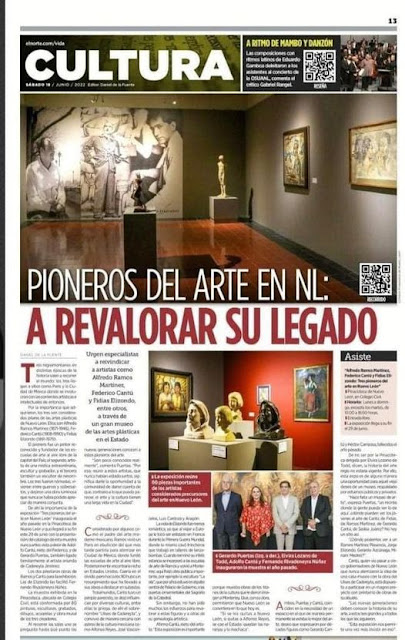
Lamagna exposición “Tres Pioneros de las Artes en Nuevo León. Alfredo Ramos Martínez, Fidias Elizondo, Federico Cantú” está conformada por alrededor de 81 obras; de estas 60 son pinturas (entre óleos, acuarela, dibujo, grabado), 30 esculturas (bronce y mármol), tres de arte objeto y una fotografía.
De Alfredo Ramos Martínez se exhibe pintura, arte objeto y acuarela; de Fidias Elizondo se presentan esculturas y de Federico Cantú se muestra pintura, dibujo, grabado y escultura.

martes, 21 de junio de 2022

  EL NORTE


Daniel de la Fuente
Monterrey, México (18 junio 2022).-
05:00 hrs
Tres regiomontanos en distintas épocas de la historia salen a recorrer el mundo: los tres llegan a sitios como París y la Ciudad de México donde se involucran con las corrientes artísticas e intelectuales de entonces.
Por la importancia que adquirieron, los tres son considerados pilares de las artes plásticas de Nuevo León. Ellos son Alfredo Ramos Martínez (1871-1946), Federico Cantú (1907-1989) y Fidias Elizondo (1891-1979).


El primero fue un pintor reconocido y fundador de las escuelas de arte al aire libre de la capital del País; el segundo, artista de una mística extraordinaria, escultor y grabador, y el tercero también un escultor de renombre. Los tres fueron nómadas, vivieron entre guerras y sobresaltos, y dejaron una obra luminosa que nunca se había podido apreciar de manera conjunta.
De ahí la importancia de la exposición "Tres pioneros del arte en Nuevo León" inaugurada el año pasado en la Pinacoteca de Nuevo León y que llegará a su fin este 29 de junio con la presentación del catálogo de esta muestra nunca antes vista a decir de Adolfo Cantú, nieto del Federico, y de Gerardo Puertas, también ligado familiarmente al artista oriundo de Cadereyta Jiménez.
Los dos prestaron obras de Ramos y Cantú para la exhibición. Las de Elizondo las facilitó Fernando Rivadeneyra Núñez.


La muestra exhibida en la Pinacoteca, ubicada en Colegio Civil, está conformada por 80 pinturas, esculturas, grabados, dibujos, acuarelas y obra mural de los tres creadores.
Al recorrer las salas uno se pregunta hasta qué punto las nuevas generaciones conocen a estos pioneros del arte.
"Son poco conocidos realmente", comenta Puertas. "Por eso, reunir a estos artistas, que nunca habían estado juntos, significa darle la oportunidad a la comunidad de darse cuenta de que, contrario a lo que pueda parecer, el arte y la cultura tienen una larga vida en la Ciudad".
Considerado por algunos como el padre del arte moderno mexicano, Ramos vivió un París en ebullición del que más tarde partiría para aterrizar en Ciudad de México, donde fundó las escuelas de arte al aire libre. Posteriormente encontraría nicho en Estados Unidos. Caería en el olvido, pero hacia los 90 hubo un resurgimiento que ha llevado a sus obras a destacar en subastas.
Trotamundos, Cantú tuvo un periplo parecido, se dejó influenciar por diversas culturas, entre ellas la griega, de ahí el sobrenombre "Ulises de Cadereyta", y convivió de manera cercana con astros de la cultura mexicana como Alfonso Reyes, José Vasconcelos, Luis Cardoza y Aragón.


La vida de Elizondo fue menos romántica, ya que al viajar a Europa le tocó ser enlistado en Francia durante la Primera Guerra Mundial, donde lo mismo cavó trincheras que trabajó en talleres de lanzabombas. Cuando terminó su infeliz estancia se incorporó a las escuelas de arte de Ramos y volvió a Monterrey: aquí forjó obra pública importante, por ejemplo la escultura "La ola", que por años estuvo en el patio central de Palacio de Gobierno, o las puertas ornamentales del Sagrario de la Catedral.


Sin embargo, no han sido muchos los esfuerzos para revalorar a estas figuras y a otras de su genealogía artística.
Afirma Cantú, nieto del artista: "Esta exposición es importante porque muestra obras de los titanes de la cultura que le dieron imagen a Monterrey. Que, con su obra, permitieron que Nuevo León se convirtiera en lo que hoy es.
"Si se los quitas a Nuevo León, si quitas a Alfonso Reyes, se cae el Estado: quedan las naranjas y la machaca".
***
Ambos, Puertas y Cantú, coinciden en la necesidad de un espacio en el que de manera permanente se exhiba lo mejor del arte, deseo que expresaron por décadas figuras como Gerardo Cantú y Héctor Carrizosa, fallecidos el año pasado.
De no ser por la Pinacoteca dirigida por Elvira Lozano de Todd, dicen, la historia del arte regio no estaría vigente. Por ello, esta expo es de alguna manera una oportunidad para aquel viejo deseo de un museo, respaldado por esfuerzos públicos y privados.
"Hace falta un museo de arte", expresa Puertas, "un recinto donde la gente pueda ver lo de aquí: ¿dónde pueden ver los jóvenes el arte de Cantú, de Fidias, de Ramos Martínez, de Gerardo Cantú, de Saskia Juárez? No hay un sitio así.
"¿Dónde podemos ver a un Ramiro Martínez Plasencia, Jorge Elizondo, Gerardo Azcúnaga, Miriam Medrez?".
Cantú, quien vio pasar a cinco gobernadores de Nuevo León que nunca aterrizaron la idea de una casa museo con la obra del Ulises de Cadereyta, está dispuesto a participar en un magno proyecto con préstamo de obras de su abuelo.
"Las nuevas generaciones deben conocer la historia de su arte, a estos tres grandes y a todos los que les siguieron.
"Esta exposición nos permite una vez más insistir en eso". "¿Dónde podemos ver a un Ramiro Martínez Plasencia, Jorge Elizondo, Gerardo Azcúnaga, Miriam Medrez?".

martes, 31 de mayo de 2022


Maestro Jesus Soriano- 

A 100 años del Muralismo


Murales Revolucionarios – épicos – sacros – históricos- tradiciones- epopeyas- decorativos mitológicos – regímenes etc.

Formación y entorno , creencias 


Antecedentes – La escuela de Paris 

La belle Epoque – primera guarra – Les Anne Folle – La gran depresión

La segunda Guarra


Los que podían costear una estancia en Paris – Las Academias en Paris

Los grupos 

El surgimiento de la Escuela de Nueva York


Los hallazgos Egipcios – Los Olmecas – Toltecas – Tula


Murales al fresco

El mezzo fresco

Técnicas

Murales externos – Piedras- fragmentación de color- Paneles- estarcidos – materiales – metales- fundición – herrería- pigmentos


Cinceles – neumáticos , tipos de piedra , laja , relieve a talle directa 

Vitrales , pintura acrílica, atoxica , grafiti